To: All
To: mrelmo
To: MP640
I would like to thank everyone for their posts, pictures, links, etc.
A special thanks to MP640 for his pictures.
A very special thanks to mrelmo for his replies and his pictures. I will use your procedure when I make my cuts.
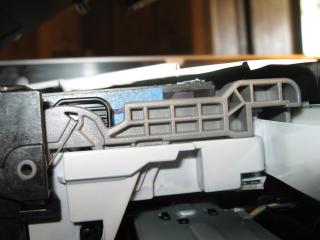
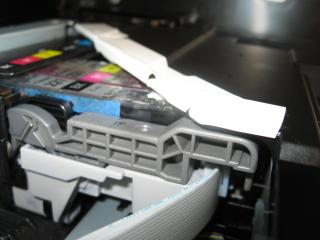
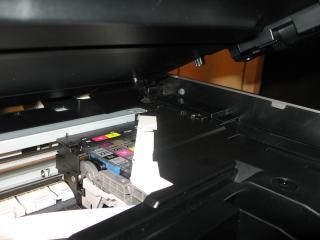
Below are pictures of my Canon PIXMA MX870 and my Dremel manual.
I used white tape to cover the edge of right wing. I did not use white paint or white wite-out because I thought that the tape would be easier to apply and see. All that is true, but the tape did not want to stick (i.e. it came loose from the edge) to the plastic. Next time I will use paint or wite-out!
It is hard to tell from the pictures, but the distance from the underside of the wing to the top of the cart(s) is a bit less than 1/8 of an inch (3.18 mm). If you press down on the print head, you will see that the print head will press down (give) a bit less than 1/16 of an inch (1.59 mm). If you add 1/8 and 1/16 you will get 3/16 of an inch (4.76 mm). To be on the safe side I would use 1/8 as the clearance.
Note: If you take a good look at what happens to the print head as it moves from one side to the other side you will see that the action is not smooth. The print head jerks around a good bit (in my opinion). You can assume from the jerkiness of the print head that your clearance is less than 1/8. What does all this mean? It means that the cap on your plug cannot be more than 1/16 high. You need to use a very low profile silicone plug or use hot glue.
In the pictures, if you look carefully, you will see a small bit of white on a cart (CLI-221BK, located on the far left of the print head). The write spot is wite-out and it covers the cap on a hot glue plug. The cap is less than a 1/16 high. As you can see the gap between the cap and the underside of the wing is not much. It looks to be around 1/16.
Let me talk about the wing. I will break the wing down into thirdsright, middle, and left (looking from the left side).
The right third has no lip. The middle third is raised (note the channels) and has a lip. Because of the lip the clearance above the carts is the same as for the right third. The left third has no lip and has the most clearance. The left third has no effect on the carts. It can be ignored if one wants to do some cutting on the wing. A quick look at the wing tells me that you will need to cut out part of the right third and part of the middle third if you want to eliminate the tight clearance. If you cut the right and middle third this will eliminate the tight clearance for the factory seal opening and the fill hole located to the right of the factory seal opening.
Based on my observation the left wing is the same (or close to it) as the right wing when comes to clearances. I could be mistaken, but that is what it looks like to me.
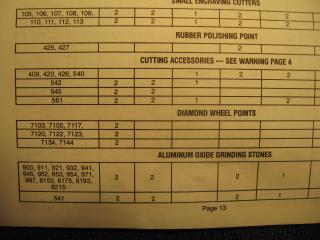
mrelmo, the catalog number of the diamond wheel is #545. If the $3.00 is not a typo, that is a damn good price for the wheel!!! I am assuming that Home Depot did not make a mistake on their pricing. I hope you bought more than one!!!!!
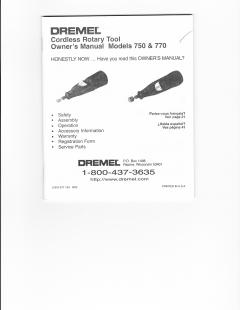
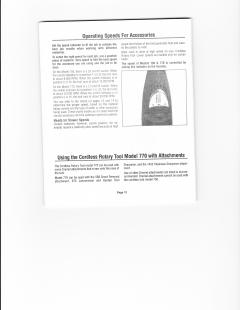
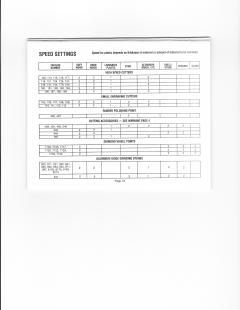
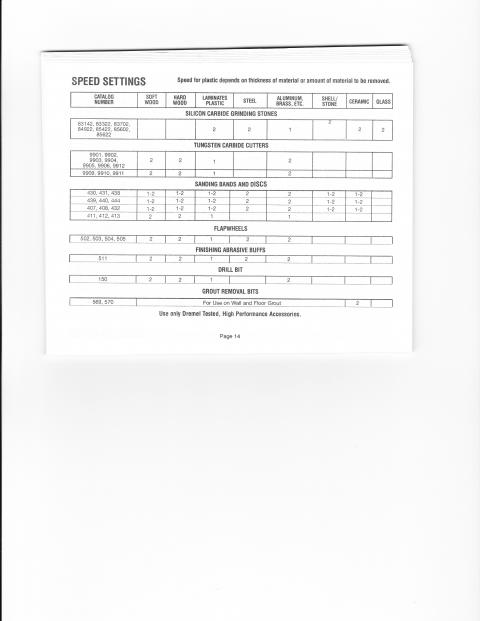
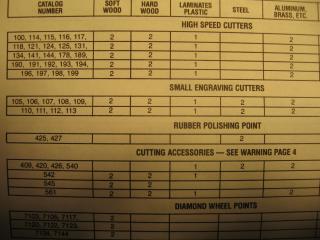
Below are pictures of pages from my Dremel manual. The pictures are not very clear (they may be unreadable).
The cover page of the manual says:
DREMEL
Cordless Rotary Tool
Owners Manual Models 750 & 770
The date says 9/02 on the front cover.
I have a price sheet that came with the tool that says 2003, so I bought the tool probably sometime in 2003 (I have lost the receipt). Note: according to the price sheet a #545 diamond wheel cost $21.10!!!!
I have the 770 model. The LO or 1 speed is 10,000 rpm. The HI or 2 speed is 20,000 rpm.
Based on the Operating Speeds for Accessories page of the manual you should use LO or 1 on plastics unless you read different. No matter what model you have I would set the speed at the lowest setting if you are cutting plastic. I am guessing the reason that the plastic melted is because the speed was too high. Im thinking that the high speed kept the dust (the plastic melted instead) down to a minimumgood thing!!!!
According to the SPEED SETTINGS tables the #545 diamond wheel was not made to cut plastics. I dont think this is a big deal if you know what you are doing. mrelmo, it looks like you knew what you were doing.
Based on reading the manual and the Quick Start Book and my limited experience with the Dremel tool here is my procedure for cutting (or whatever) with the Dremel tool.
1. Wear eye protectionbig time.
2. Read the SPEED SETTINGS tables that are in the manual.
3. Start with the correct mandrel and accessory for the job. Read the manual and the Quick Start Book that came with the tool.
4. Use the slowest speed at the start. A high speed may cause the accessory to disintegrate!!! EYE PROTECTION!!!!!!!!
5. Do not let the accessory touch the surface when you turn on the tool. Have the accessory at speed before you touch the material.
6. Cut at a slow pace.
7. Do not cut too deep. If you cut at a fast pace and cut too deep the accessory may not be able to stay together. EYE PROTECTION!!!!
8. Adjust the speed to a higher setting once you know that everything looks O.K. I would do this in steps if you are cutting with an accessory for the first time and/or cutting a material for the first time.
Thank you.