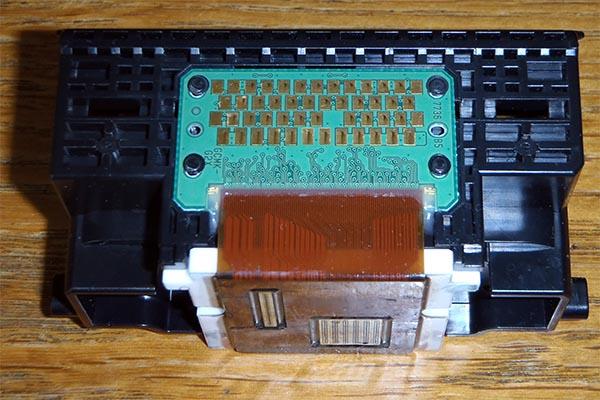
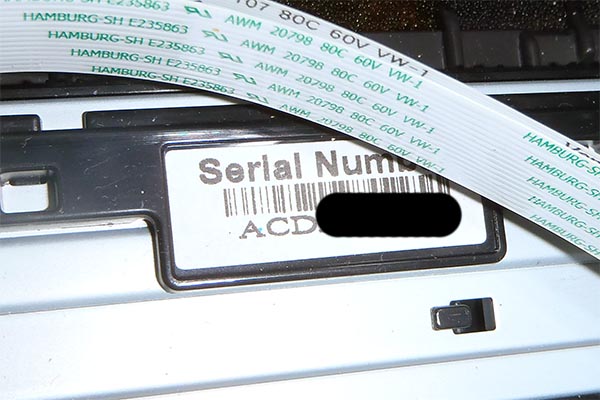
While it would be highly desirable to determine to the root cause of your (or anyone's) print head electrical failures, so far no one in this group has been able to do so. As for pinnout information, that is not included in service manuals, and is probably closely held proprietary information with Canon.
The construction of the embedded electronics within a Canon nozzle plate is very similar to that of a computer CPU or other large scale integrated circuit die. The main difference is that THIS die must handle very high pulsed current densities in order to operate the microscopic heaters within every nozzle. With printer manufacturers always seeking to increase both printing speed and resolution, they keep challenging the physics of thermal degradation of the die. Eventually some portion of the microscopic circuitry is damaged and the result?
1. Half the nozzles on one color stop firing. Apparently there is no embedded monitoring for this type of failure in the printer's firmware.
2. Printhead overheating errors become reported.
3. Logic boards (the stationary electronics at the other end of the ribbon cables) become damaged by printhead failures that overload the logic board.
4. Unexpected errors become reported.
To this end, I have always operated my Canons at "Low Speed" or "Quite Mode" to reduce the heating duty of the printhead, with the intention that this should preserve the circuitry. Another option to reduce duty is to select a printing mode in the driver that forces uni-directional printing (avoid draft quality printing).
If you do eventually decipher the pinnout, that would be a first for this forum! Good luck.
Of course, the REAL solution is to avoid thermal inkjet printing altogether...switch to Epson for a more durable printhead!
Wayne