
[Tool] ChromIQ – a macOS and Windows GUI for ArgyllCMS printer profiling (v3.8.0)

pharmacist

Printer VIP
Platinum Printer Member
Joined
May 29, 2007
Messages
3,134
Reaction score
1,816
Points
333
Location
Ghent, Belgium
Printer Model
SC-900 ET-8550 WF-7840 TS705
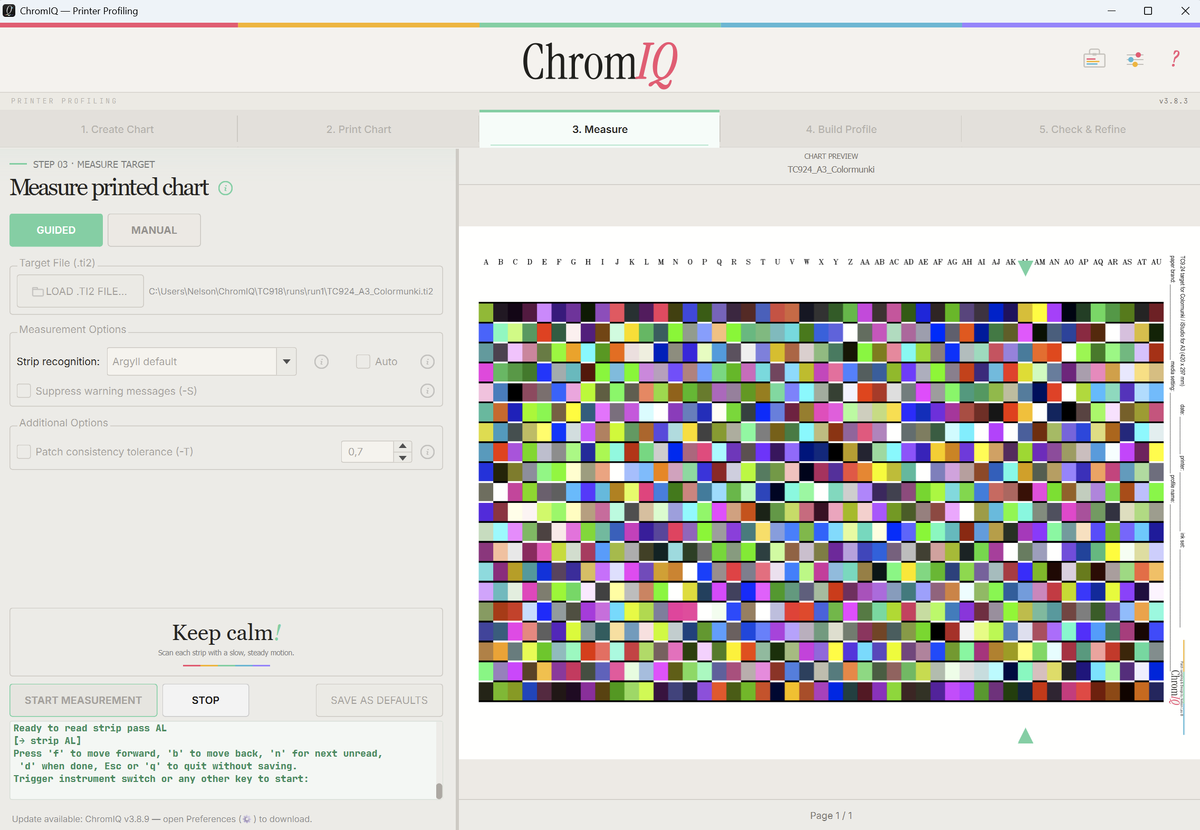
OK here it is:
1780905264958.png


I have compress the whole TC9.24 (slightly modified TC9.18 target with 3 extra blacks + 3 extra whites) on a single sheet of A3. The target can be scanned with both the Colormunki/i1Studio as well as the i1Pro1/2/3 (turn around 90 degrees). Above you can see I have done test printing on normal paper (A3) and see if it can be scanned (no strange arrow deformations). Hopefully it will do a better job than the canned Canon profile you are using now.
 

Attachments

  • TC924_A3_Colormunki.zip
    529.1 KB · Views: 4

itsab1989

Fan of Printing
Joined
Feb 11, 2026
Messages
135
Reaction score
59
Points
60
Printer Model
Epson ET 8550, Canon Pro 300
Wow, that was fast! Thanks a lot!
You think it makes sense in any way to create a seperate target with even more patches for A3+ which is quite a bit larger than regular A3 or would there be no real benefit?
 

pharmacist

Printer VIP
Platinum Printer Member
Joined
May 29, 2007
Messages
3,134
Reaction score
1,816
Points
333
Location
Ghent, Belgium
Printer Model
SC-900 ET-8550 WF-7840 TS705
Actually for modern printers (very linear in behaviour and especially on printers with at least 1 grey ink) it is not necessary to create larger targets: The TC9.18 was already designed to have good neutral grey reproduction on CcMmYK printers (without having a grey ink). I could make a larger A3+ target with those extende greys included if you want, but I would try this target first: probably it will not be necessary.
 
Last edited:

itsab1989

Fan of Printing
Joined
Feb 11, 2026
Messages
135
Reaction score
59
Points
60
Printer Model
Epson ET 8550, Canon Pro 300
I have added it to the app and the update is on its way. Will try it after it is online.
I trust your expertise here. If there is no benefit at all in creating a bigger target then we leave it as it is. Otherwise why not use the additional space of A3+ at least if it does not hurt?
 

pharmacist

Printer VIP
Platinum Printer Member
Joined
May 29, 2007
Messages
3,134
Reaction score
1,816
Points
333
Location
Ghent, Belgium
Printer Model
SC-900 ET-8550 WF-7840 TS705
Something else: would it possible for Claude to have a look at the ArgyllCMS i1Pro driver and compare it with the proprietary i1Pro2 driver (with flashing green lights when a row is down properly, red light when error and double blue light when the wrong patch row is read etc) and write a new ArgyllCMS compatible driver that has the flashing knob fuctionality of the X-Rite driver ?
 
Last edited:

itsab1989

Fan of Printing
Joined
Feb 11, 2026
Messages
135
Reaction score
59
Points
60
Printer Model
Epson ET 8550, Canon Pro 300
IMG_0524.jpeg


Just printed it and will do the measurement once it is dryed. It’s a little embarrassing but this will be the first time I will actually use my own app for a real profile and not just for testing.

Regarding your questing - I will ask Claude about this but I am not sure if this will work. As far as I understand the driver used for Argyll is not directly created by Graeme Gill but is an open one. And you would need and SDK from X-Rite to get things to work. But I may be wrong and will try.
 

itsab1989

Fan of Printing
Joined
Feb 11, 2026
Messages
135
Reaction score
59
Points
60
Printer Model
Epson ET 8550, Canon Pro 300
@pharmacist

Here's an answer you can relay to your user. Short version: it's theoretically possible but it's a large, low-level
project that lives in ArgyllCMS itself — not in ChromIQ — and it carries real reverse-engineering and licensing
hurdles. Claude can help with parts of it, but it can't just "diff the two drivers and emit a new one."

Here's the reasoning, in terms you can forward:

1. ChromIQ never talks to the instrument directly.
ChromIQ is a GUI wrapper. It runs ArgyllCMS's command-line tools (chartread, colprof, etc.) as separate processes and
reads their text output. It has no USB connection to the i1Pro. So the blinking-LED behaviour cannot be added in
ChromIQ's Python code at all — it would have to be added inside ArgyllCMS's C driver, and then ChromIQ would just
benefit from it for free. Any "new driver" is an ArgyllCMS change, not a ChromIQ change.

2. The LED feedback is an i1Pro2 hardware feature, not an i1Pro one.
The original i1Pro (Rev A–D) has no RGB status LED — there's nothing to flash. The green/red/blue indicator is
specific to the i1Pro2 (and i1Pro3). So this request only makes sense on i1Pro2 hardware.

3. The "compare the two drivers" step is the hard, legally sensitive part.
- ArgyllCMS's i1Pro/i1Pro2 driver is open source (Graeme Gill reverse-engineered it; it's GPL/AGPL). So that half is
readable.
- The X-Rite driver is closed and proprietary. There's no source to compare against. Figuring out the exact USB
commands that drive the LED (good strip → green, wrong row → double-blue, error → red) means reverse-engineering
X-Rite's closed driver or capturing live USB traffic. That's slow, error-prone, and on shaky legal ground if the goal
is to copy proprietary behaviour. Claude can't conjure that protocol — without packet captures or existing
documentation, the command set simply isn't available to it.

4. Even with the protocol known, it's a fork-and-recompile job.
You'd be editing ArgyllCMS's C source (the spectro/i1pro* files), wiring LED commands into the strip-read
success/failure path, recompiling Argyll for every platform you ship (macOS/Windows/Linux), and redistributing that
forked Argyll. ArgyllCMS's licence (Graeme Gill's AGPL-based terms) places conditions on redistributing modified
binaries, so that needs checking before shipping.

5. The pragmatic alternative — which ChromIQ already partly does.
You can reproduce the user experience of that feedback at the GUI level without touching the instrument's LED: ChromIQ
already parses chartread's output, does its own stripe detection, and shows on-screen green/red status and "wrong
strip" dialogs. Strengthening that on-screen + audible feedback gives users the same "row read OK / wrong row / error"
signal without a driver rewrite. It just lives on the screen instead of on the device.

Where Claude genuinely helps: reading and explaining Argyll's i1Pro source, writing the C once the LED command bytes
are known, and building the richer on-screen/audible feedback in ChromIQ. Where it can't help by itself: extracting
the proprietary LED protocol from X-Rite's closed driver — that needs real hardware USB captures first, and that
captured-protocol approach is the actual bottleneck, not the coding.

So: not impossible, but it's "fork and extend ArgyllCMS's C driver after reverse-engineering X-Rite's USB LED
commands," not a quick driver swap — and the realistic near-term win is better on-screen feedback in ChromIQ.
 
Last edited:

itsab1989

Fan of Printing
Joined
Feb 11, 2026
Messages
135
Reaction score
59
Points
60
Printer Model
Epson ET 8550, Canon Pro 300
I wanted to share a message from Knut and hear your thoughts about it. His script that he mentions can be downloaded from here: https://github.com/soul-traveller/Argyll_Printer_Profiler


Hi Sebastian,

Great to see the progress happening on printerknowledge.com and found it cool to see the good results that pharmacist showed using the 1160 patch TC9.18 plus Spyder grays patch set, confirming its good value.

Here are a lot of thoughts and suggestions I have that you, pharmacist and the printerknowledge.com community might consider:

1)

You (Sebastian) asked him (pharmacist) to make an A3 / A3+ target, and he made a target for the TC9.24 target (which is very useful), but I assume you actually meant to make a target using the 1160 patch set, no?

I assume pharmacist chose that patch set because the 1160 patch TC9.18 plus Spyder Grays does not easily fit on a single page. However, I would like to mention the following (using the previously provided 1168 patch set for TC9.18 plus Spyder Grays), which could be improved upon and included into ChromIQ, if useful:

The argyll-printer-profiler script has a i1Pro 1 page target example made (find it under the expert group of the “Pre-made_Targets" folder):
“i1Pro-Expert-A3-1168p-1page-w8.0mm-47x25-landscape_TC918+Spyderprint_grays-randomized”
Command: printtarg -v -P -ii1 -T200 -p420x297 -M8 -R161 -a0.98 -A0.6 chart_name

As you can see it has 8mm wide patches, so it is not really suitable for iStudio/ColorMunki, but would be useful to have in ChromIQ for the i1 Pro.

The best low-page count example for the iStudio/ColurMunki I would suggest are these (best seed value has not been provided in these examples):
- CM-Expert-A3-1168p-2pages-w11.5mm-23x26-portrait_TC918+Spyderprint_grays-randomized
Command: printtarg -v -b -P -iCM -h -T200 -p297x420 -a0.88 -M6 chart_name
- CM-Expert-A3-1168p-2pages-w11.5mm-34x18-landscape_TC918+Spyderprint_grays-randomized
Command: printtarg -v -b -P -iCM -h -T200 -p420x297 -a0.85 -M6 chart_name

Both 11.5mm wide patches, so close to the threshold for use with iStudio / ColorMunki (I think about 10-11mm is a practical minimum).

Then under the intermediate group (A3 and A3+)(best seed value has not been provided in these examples):
- CM-Interm-A3-1168p-3pages-w14.0mm-19x22-portrait_TC918+Spyderprint_grays-randomized
Command: printtarg -v -b -P -iCM -h -T200 -p297x420 -a1.07 -M6 chart_name
- CM-Interm-A3-1168p-3pages-w14.0mm-28x14-landscape_TC918+Spyderprint_grays-randomized
Command: printtarg -v -b -P -iCM -h -T200 -p420x297 -a1.05 -M6 chart_name
- CM-Interm-Ledger-1168p-3pages-w13.5mm-29x14-landscape_TC918+Spyderprint_grays-randomized
Command: printtarg -v -b -P -iCM -h -T200 -p432x279 -a1.013 -M6 chart_name
- CM-Interm-Tabloid-1168p-3pages-w14.0mm-18x22-portrait_TC918+Spyderprint_grays-randomized
Command: printtarg -v -b -P -iCM -h -T200 -p279x432 -a1.076 -M6 chart_name

These are perfect patch size for easy reading on ColorMunki and big enough to get more samples read for good results without lots of re-reading.

I would love to see these made properly for the new ChromIQ (both portrait and landscape as you can see). If not specially made by pharmacist, at least created as automated options in the preset list (using only the ti1 file as basis), in addition to the built-in versions that also have tif images included.

There are even two A2 examples I made, which are only one page (for those with larger printers):
- CM-Interm-A2-1168p-1page-w12.5mm-31x38-portrait_TC918+Spyderprint_grays-randomized
Command: printtarg -v -b -P -iCM -h -T200 -p420x594 -a0.92 -M6 chart_name
- CM-Interm-A2-1168p-1page-w12.5mm-45x26-landscape_TC918+Spyderprint_grays-randomized
Command: printtarg -v -b -P -iCM -h -T200 -p594x420 -a0.90 -M6 chart_name

It would also be important to make sure the naming of the presets are understandable compared to the content of each choice.


2)
For the built-in options in the preset list:
a)

As mentioned, possibly add the above options as pre-configured options based on ti1 files (not including tif, but generating tif files), or optionally especially make them as built-in like pharmacist has done for others.

b)
Is there a way that the command used to make the built-in targets can be stored in the files, such as a TAG in the ti3 file, or similar? This way anyone could generate the same chart (including the seed number used, in order to get same layout) in any other page size and layout if needed. This would make the built-in profiles that are proven as good more versatile and transparent for users to play around with.

c)
The preset list in tab "1. Create Chart ==> Manual” still does not show if they are landscape or portrait, and “by Pharmacist” could still be move to the pop-up info for making space for details in the naming, as previously suggested. That would be my logical preference at least.


3)
The Welcome to ChromIQ window:

a)
I think the guides and bullet-point lists are good, although I have not quality controlled the content. Though I suggest to make a "Print List” button, so that a user may print it on a A4/Letter page as text for more easily checking off each point and following progress of their actions. This is not always so easy on-screen, and some may prefer to have a physical paper to work with.

b)
ArgyllCMS has some long and complicated and confusing examples and descriptions on their site (https://argyllcms.com/doc/Scenarios.html) on how to determine ink limits for a printer. Some sites also provide special images to use for determining these limits (step-wedge Total Area Coverage chart), or use tools such as ⁠Adobe Exchange Total Ink Limit Finder.

Some guidance can be found at sites such as: ⁠ArgyllCMS Ink Limiting Discussion or ⁠DPReview ArgyllCMS Printer Profiling Thread.


Is it possible, or a good idea, to add another guide in the welcome window that gives a good and easy to understand guide to doing this? And also then provide images needed for determining the limits?

This is not relevant for me, but those that really are into perfecting the results.


4)
When using "Edit / Create Chart layout tool”:
a)

It would be very useful if it were possible to load one ti2 file (or maybe even ti1 or X-rite Profiler file, and then be able to append or add another set of colors from another file and place it at the beginning or the end of the chart swatch set). This would make it easier to combine sets.

b)
The professional ColourSpace tool, or apps like ⁠Color Patch Sequence Viewer make it possible to show the coverage/distribution of color patches in a cube (such as a 3D RGB Color Cube of a 17^3 grid sequence patch set), making it easier to grasp coverage and patch color density, as well as see if there are areas that are unevenly covered in a selected chart.

Is it possible to create such a view, so that one may rotate and zoom in/out in a cube type view of the loaded patch set? Would this, and possibly some other analysis tools shown in the Color Patch Sequence Viewer link above, be a good idea to implement (simplest possible first I would assume)?


Great work to all that are contributing :)


Cheers,
Knut
 
Top