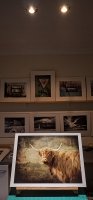
Now you've calibrated everything: what lights do you use?

Hi all

now that winter has come I feel I need better lighting to check my prints from my Epson R3000. Long story short:

I see 3 options:

1. Halogens: only SoLux have something like 3500K with CRI>90 but they are not available in Europe
2. Fluorescents: Osram and Philips lamps for proofing, >5000K CRI>90 but Ifeel they may be too cool...
3. LEDs: not much here, most of them are <3000K CRI>80

What do you use? What do you suggest

Thanks a lot!

Dimitris

I`m in Canada and was around -30 Celsius couple of days ago. Think the best light is midday in Florida. ;);)

RS
 
In my idea, when the monitor and printer is calibrated, and you are confident about this by printing during daytime, soft proofing is the way to go.
I sometimes doubt about a print in the evening and adjust, but the next morning I see I should have trusted my screen.
Also some inks/papers are much darker when wet, you can't judge them coming out of the printer.

I changed my halogen spots with 3000K LED's and they do not seem unnatural to me.
 
Daylight, or the light under which the image is to be viewed, if possible. Printing, proofing is done in the same llight condition as the profiling. Prints are not evaluated for 12 hrs minimum. Allowing ink to dry on the paper.
 
In my idea, when the monitor and printer is calibrated, and you are confident about this by printing during daytime, soft proofing is the way to go.
I sometimes doubt about a print in the evening and adjust, but the next morning I see I should have trusted my screen.
Also some inks/papers are much darker when wet, you can't judge them coming out of the printer.

I changed my halogen spots with 3000K LED's and they do not seem unnatural to me.

Hi Palombian

I do softproofing but I see differences especially with some high contrast B&W images that unless lighted properly, there are plenty of details lost in the shadows. It might very well be that eyes adjust to the highlights more easily.

Yes, I also plan to try a couple of LED bulbs ...

Thanks for the tip!
 
At 6500 degrees, the typical LED monitor is about as close to "indirect sunlight" as you can get.

Are you sure that LED lighting is so warm? That's hardly cooler than halogen incandescents. I have a string of LED lights are that obviously very cool white. A quick poking around on the intertubes shows that there are a lot of 5000-6000 degree bulbs out there in various configurations.

Yes, for example look at

http://www.osram.com/osram_com/prod...ic-a-advanced/index.jsp?productId=ZMP_1069944

there are also 4000K versions

http://www.osram.com/osram_com/prod...ic-a-advanced/index.jsp?productId=ZMP_1133370
 
RogerB said: Solux is very smooth. How have you set them up, as a viewing booth or room lighting?
I have them as ceiling mounted downlighters to give me a reasonable "viewing area". With this arrangement the print brightness is a near perfect match to my monitor brightness (120cd/m2). This is how it looks with an A2 prnt.
_1080536-2.jpg
 
These product specs highlight one of the "features" of LED lighting, namely that they have little or no UV content. Even a Cree Q5 cool white LED has next to no output below 410nm. This means of course that they don't really excite the optical brightening agents in papers in the way that daylight does. Solux lamps have a similar UV content to D50, so rendering on papers with OBAs is better.
 
This means of course that they don't really excite the optical brightening agents in papers in the way that daylight does. Solux lamps have a similar UV content to D50, so rendering on papers with OBAs is better.

A very valid point! Didn't think of that.
 
Hi Palombian

I do softproofing but I see differences especially with some high contrast B&W images that unless lighted properly, there are plenty of details lost in the shadows. It might very well be that eyes adjust to the highlights more easily.

Yes, I also plan to try a couple of LED bulbs ...

Thanks for the tip!

Hi Dimitris,

I can't see everything on the screen exactly as on the paper either (certainly not on my 96% sRGB monitor :)), but as 3dogs states correctly, the print can't be trusted before it is dry (seems to me dye inks and matte papers change more than pigments and/or glossy).
But when you do a number of prints in a row with a proven paper/printer/profile you get the knack for small adjustments.
I print for my own use and to give away to family and friends, first a fast one on 10x15 or A4 on a dye printer, the good ones later on A3 with pigment ink.

Theoretically LED's should be avoided because of their bad CRI, so test yourself.
Warm white LED's seem to be cool whites with a yellow filter, no idea how they change in time.
I experimented with a mixture of brands/types. Philips emulates halogen the best, but a bit warm at 2700K. Some cheap no-names are good, others junk.
Even with the actual low prices it takes a few years to recover the cost on your power bill, but I do it by conviction (and to avoid a brownout in Belgium since half of our nuclear plants are out of order).

 
Last edited:
Back
Top