I was looking forwards to these test results, but as the months rolled by I changed sides, because I wasn’t expecting the outcome to be as poor as this, I wanted to test to destruction and I did..
I’ll start with the bog standard plain copy paper, the prints on the left are only an illustration that were printed out freshly just to show what I started with..

Firstly I’ll start with the Canon 53 bottled ink, because it’s the only ink that had any proper resistance to fading, now if Canon 53 colour bottled inks are as good as their black then they are well worth the extra cost, these results couldn’t have been better..

The next is just the typical 3rd party black dye ink that can be bought from many 3rd party suppliers, and from what I can tell, most if not all suppliers sell exactly the same inks, this ink is called FotoRite photo dye black ink from CityInk Express..
The next ink from OctoInkjet looks a mirror of the FotoRite dye ink, I only tested these two inks because that’s all I’ve used for the past 10 or 12 years, so I won’t lay any criticism towards these two inks, because I couldn’t have got any better ink anywhere else at that time..


Clearly these dye inks ware incapable of stand up to my very harsh test, and I don’t reckon any other 3rd party dye ink could either, so don’t blaming the ink or the suppliers for their poor preformance, and I wouldn’t expect anyone to expose their prints to anything like this in their own everyday environment..
I moved on to the performance of the dye ink on Photo glossy paper.. This Photo Paper is not what most would call quality Photo Paper, again it’s the glossy paper I use for all my A4 colour prints, and I’m perfectly happy with it, it's Sihl Premium glossy paper from United Office.
There is not much between these two 3rd party inks on the glossy paper either, but this is what you should expect if you use 3rd party dye ink with average cheap quality photo paper, and you expose them to bright light for a long period of time.. But you can reprint the images again if they get to poorly, that’s what I do..
The Canon 53 bottled ink faired out quite a bit better..


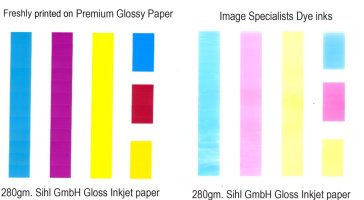
This next bit was not supposed to be in this test but I taught why not and added them in a week later, for this I used Image Specialists dye inks From OctoInkjet printed on my i9950 and the Canon 56 pigment inks on my Maxify.. Again printed on the Sihl Glossy Paper..
Now I reckon the dye inks stood up to the test extremely well, compared to the black dye ink, these inks are 12 years plus old and still going strong, but are mostly unavailable anymore..
Now the Canon bottled 56 pigment inks faired out lousy, in fact the colour vamoosed nearly as fast as the coloured dye inks did, at least the dye inks were still mostly present and held their colour and didn’t disappear.

It would seem from these tests that the only way to be sure to get quality inks is to use OEM cartridge inks, because these Canon 56 pigment bottle inks are as poor as any 3rd party pigment ink.
On conclusion, will this change what inks I use or buy going forwards, not in the slightest, I’ll continue to buy 3rd party ink as long as they remain cheaper than OEM inks, and I will continue to support 3rd party ink suppliers because they allow me to print as much as I want, without incurring the huge cost of OEM..
With the rise of bulk CISS tank printers, the OEM bottle ink industry may seem Like a better alternative to 3rd party inks, but are they really, we don’t know how good all the bottled inks are to the real OEM cartridge inks, well the 56 pigment inks were certainly crap in my test..
P.S. It’s just a pity Image Specialists are no longer with us..




 ) together with Hahnemuhle and the like.


