Hi ROX
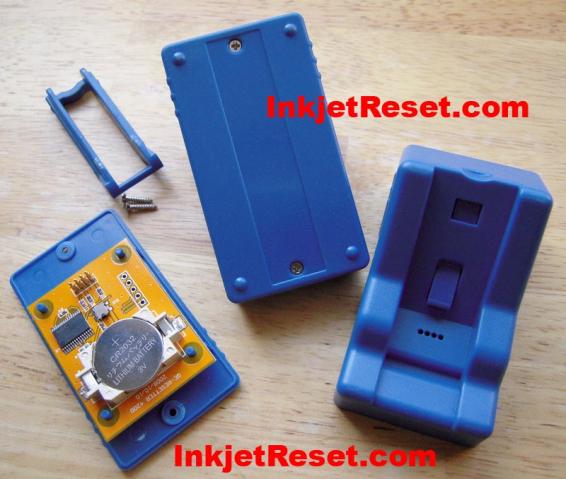
If you own a digital or analog multimeter, you could try testing the voltage between the leftmost and rightmost circular golden pads. With new and good batteries you should measure around 4.65 volts. If the voltage is lower or even zero, either batteries are dead or there is a contact problem.
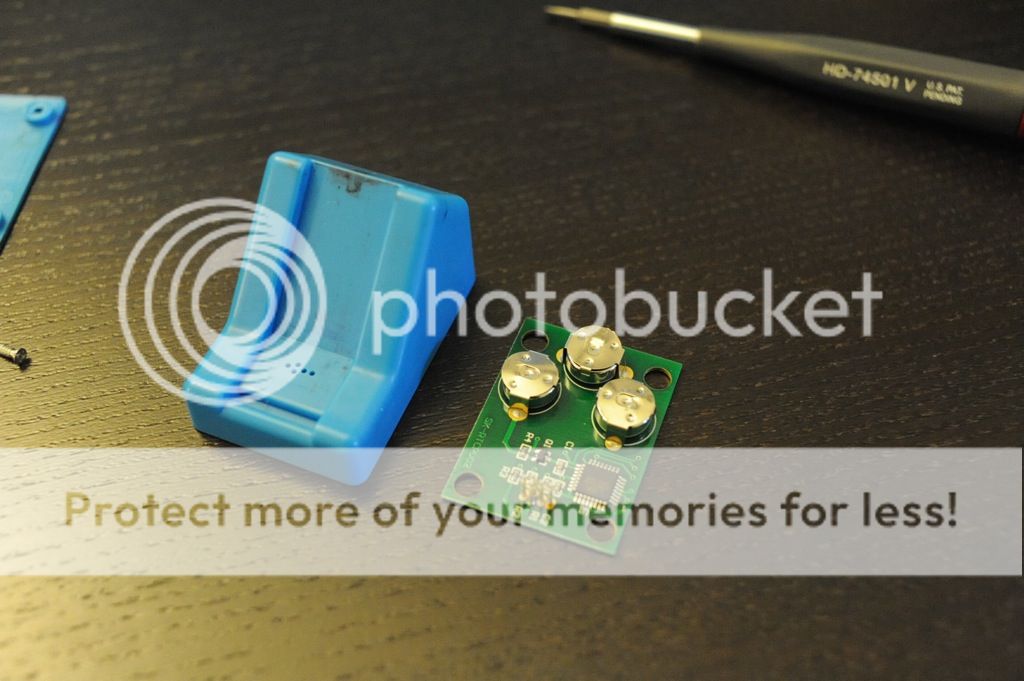
I noticed a difference in how the batteries are switched on and off between your resetter and my Original Redsetter plus the blue one owned by Ron350.
The redsetter and Ron350's blue resetter both use a microswitch to switch the battery on and off. Your resetter uses an extra contact pin to switch the battery on. Note the use of 5 contact pins, as opposed to the use of 4 contact pins on the other resetters. When in use the double set of pins make contact through the longer contact pad on the chip.
I think this system is the Achilles' heel of your resetter. Check that these two contact pins are clean, and that the spring loading of the pins work.
If you are going to buy a new resetter I recommend the Original Redsetter or one like that owned by Ron350. Even if it is more expensive, a USB powered model has no battery problems.
Mikling is right, battery voltage should ideally be tested under load, and the load current should equal the current drawn by the resetter. But I found that the no load voltage is a fairly accurate indicator of the battery condition.
To solve a problem with my Redsetter I have done tests with an external battery holder, allowing different batteries to be tested easily, connected to my Redsetter and measuring the voltage both under load when doing a reset and under no load. Substituting the Redsetter with different resistors for loading the battery I found one gave the same voltage drop over the internal resistance of the battery. Ohm's law then gave me the current drawn by the resetter and the internal resistance of the battery. That is how I found that some no-name CR2032 were no good, others were fine. IIRC the current drawn by the Redsetter was 14 mA. Some data sheets for CR2032 indicate that 10 mA should not be exceeded.
The reason for this indirect testing is that digital multimeters are optimised for use as voltmeters, the internal resistance is too high when used as a milliampere meter for this purpose.
I also have an Original Redsetter for PGI-520/CLI-521 cartridges, so I may repeat the test and compare the current drawn by the two resetters. I have seen the opinion that the first Redsetters were battery eaters, and newer models are better. Now I have a chance to find out.